Outcomes

Guide of ethical use of LLM generative AI Systems in Higher Education
This Guide provides practical, role-specific guidance for the responsible adoption of Large Language Models (LLMs) and Generative AI (GenAI) in higher education. It synthesizes current institutional practices and scholarship to help educators, students, and university leaders make informed, values-aligned decisions about when and how to use GenAI. The work draws on a thematic analysis of materials from 20 leading European universities and on six collaboratively developed case studies gathered within the ADMIT partnership, offering a balanced view of opportunities and risks in real academic settings.
Institutional Self-Assessment Tool
This document reports on the design, implementation, and initial deployment of the ADMIT self-assessment tool for the ethical use of Generative AI in higher education. It describes how the ethical taxonomy was operationalised into a set of indicators, transformed into three role-specific questionnaires, and linked to tailored feedback messages. The document outlines the methodological choices made in formulating items and feedback, the technical realisation of the web-based application, and illustrative use scenarios for students, educators, and institutional leaders. It also highlights how the tool can be embedded into broader institutional strategies for responsible GenAI adoption and briefly points to its current limitations and planned extensions within the ADMIT project.
Report on policies relating to the use of LLM tools within higher education
In this report you will find a structural overview of the current landscape of the definition and application of specific policies on the use of Generative Artificial Intelligence in Higher Education with an emphasis on governance. Various institutions establish policies governing the use/development/implementation of Artificial Intelligence at different levels, including local (such as universities), national, and international institutions (such as the European Union and UNESCO).
Download here
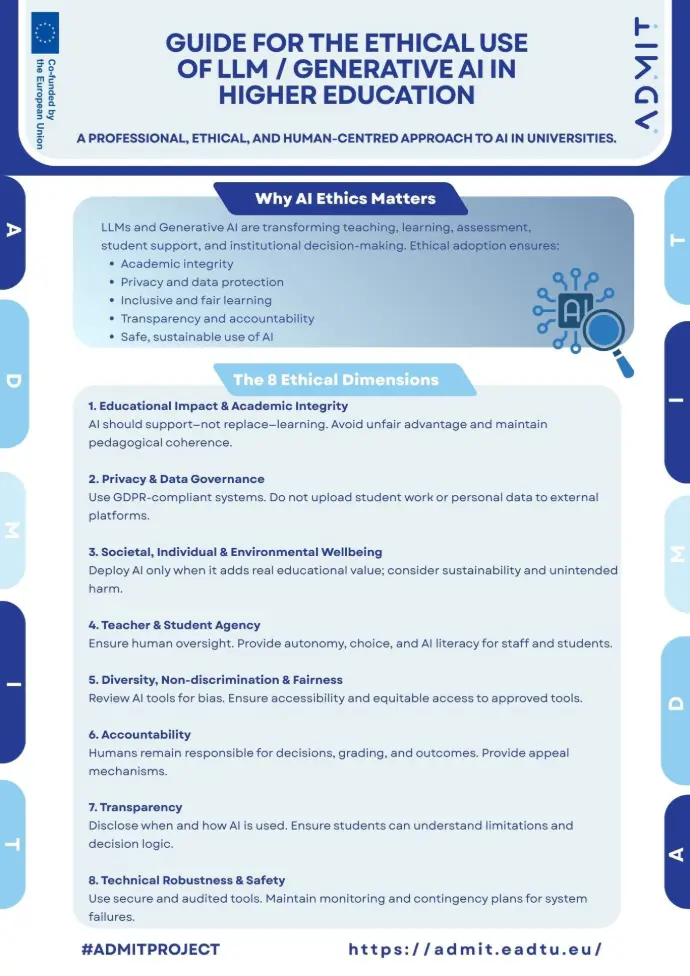
ADMIT Project Releases Flyer Previewing Its Ethical AI Guide
Check out our new flyer introducing the key themes of its upcoming Guide for the Ethical Use of LLM/Generative AI in Higher Education. The flyer outlines the guide’s eight ethical dimensions, ranging from data governance and human agency to fairness, accountability, and technical robustness, and illustrates how these principles translate into practical considerations for educators, students, and institutions.
It also highlights the main risks and opportunities emerging from the use of generative AI in academic settings, offering a concise overview of the areas the full guide will address in greater depth.
Download here
Use of LLM tools within higher education: Report 2
This systematic literature review synthesises 147 peer-reviewed studies published between
October 2024 and July 2025 on the use of Large Language Models (LLMs) in higher education.
Building on the earlier D2.1 report (Bektik et al., 2024), which provided an early-stage
snapshot of potential benefits and emerging concerns, this deliverable consolidates and
extends the evidence base. Compared with D2.1, it examines a larger corpus (147 vs. 112
studies), provides clearer thematic organisation aligned to three research questions, and
integrates new insights on institutional policy, inclusion, and emerging practices.
Download here

Report on trends and policies and practices on the use of LLMs and generative AI in the partnership: Report 2
This report examines current developments and temporal changes in the use of Large
Language Models (LLMs) and Generative Artificial Intelligence (GenAI) in higher education
across institutions participating in the ADMIT project (Generative AI and Large Language
Models in Higher Education). The findings highlight considerable differences in awareness,
usage, and institutional approaches to integrating AI technologies into educational contexts.
Download here

Report on the LLM-ed framework for Learning Design
The LLM-ed Framework provides a structured guide to help teachers integrate Large Language Models (LLMs) into learner-centred course design in higher education. It promotes inclusive, ethical, and effective AI use by framing LLMs as supportive tools that enhance creativity, efficiency, and active learning while preserving teachers’ professional judgment.
Download here

Use of LLM tools within higher education: Report 1
This report is based on a systematic literature review. It examines the impact of Generative Artificial Intelligence (GenAI) and Large Language Models (LLMs) on higher education. The rapid advancement of GenAI tools, such as ChatGPT, has transformed educational practices, bringing both significant opportunities and critical challenges.
Download here

Feature Report on trends in policies and practices on the use of LLM and generative AI in the partnership: Report 1
This report provides a comprehensive analysis of the current trends, policies, and practices related to the use of Large Language Models (LLMs) and Generative AI in higher education across the partner institutions involved in the ADMIT project. The findings are based on qualitative and quantitative data collected from key stakeholders, including students, teachers, IT/support staff, and administrators. The study reveals significant variability in awareness, application, and institutional strategies for leveraging AI in education.
Download here
